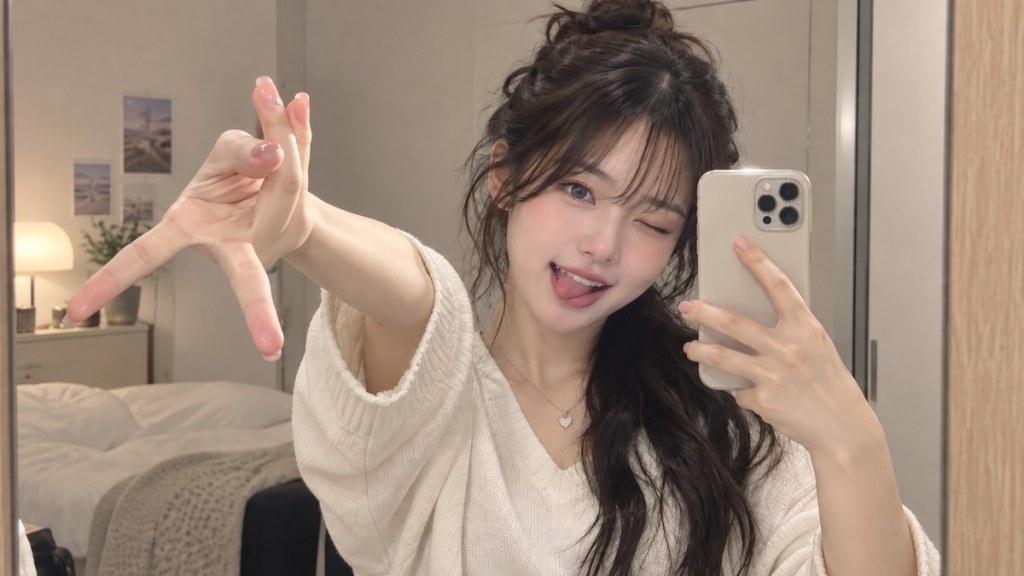
If you spend enough time looking at K-pop photos or Korean short-form videos, you may start noticing a slightly unusual version of the familiar V sign.
Someone holds up two fingers for the camera, but instead of pointing up, they point down.
The expression gets a little more playful, too.
Then comes a drawn-out:
“Yaho~!”
The first time or two, it may look like just another photo pose.
But then the gesture shows up in another photo. A short-form video has a similar expression and the same drawn-out “Yaho~.”
That is when the questions start.
Why flip the V sign instead of doing it the usual way?
And why does “Yaho~” come with it?
It did not stop with one viral moment.
The pose started showing up in celebrity photos and press events, and even in parody photos based on moments that were getting attention at the time. In Korea, people even started calling it the “Yaho pose.”
You Don’t Just Make a V Sign—You Flip It
Unlike a regular V sign, the two fingers point down.
That small flip makes the pose look much more playful—and much more deliberate.
The hand gesture itself is not completely new.
It is commonly associated with gyaru peace, a pose that had already appeared in K-pop photos.
This time, though, the pose came with a more animated expression and a distinctive way of saying “Yaho~.”
Suddenly, the familiar hand gesture felt like more than just a pose. It became a quick way to play a different character for the camera.
Add “Yaho~,” and an Ordinary Photo Suddenly Feels More Playful
On its own, the flipped V is a photo pose.
If you know a little Korean, though, “Yaho~” can actually be confusing.
This is not the Korean “yaho” people shout from a mountaintop.
It is closer to the casual Japanese greeting yahhō (やっほー).
The phrase that really took off in Korea was “Geoje, Yaho~!” Geoje is a city in Korea.
But you do not need to know much about Geoje to understand the trend.
What stuck with people was less the place name than the whole “Yaho~” moment.
Add “Yaho~,” and it becomes a little scene.
On Korean social media, people also started swapping in different names or places—“___, Yaho~!”—making it easy to create their own versions.
One Small Pose Change, and Suddenly You Look Like a Different Character
You do not need to change your outfit or hair, or add any special props.
Someone who was just smiling for the camera can suddenly look more animated, and a casual selfie with friends can start to feel like a styled shot.
In Korea, even a small hand gesture can catch on as a photo pose. Finger hearts are one familiar example.
You do not need to know much about gyaru culture—or see yourself as a gyaru—to join in.
Your usual style does not really matter.
In that moment, the question is simply:
“What kind of character do I want to be for this photo?”
In Photos, It’s a Pose. In Short-Form Videos, It Becomes a Scene
In a photo, all you see is the flipped V and the expression.
In a short-form video, the whole moment unfolds: someone looks at the camera, raises a hand, changes their expression, and draws out “Yaho~.”
There are no long lines to memorize and no complicated dance to learn.
What was just a pose in a photo turns into a few seconds of playing a character on video.
The same pattern shows up a lot in Korean short-form videos these days: people copy not just a phrase, but the way it is said, the expression, and the hand gesture that come with it.
So You Start Thinking, “There’s That Pose Again,” Before You Even Know What It Means
You see the flipped V in one photo.
Then the same hand gesture shows up in a short-form video.
Someone else makes a similar expression and says, “Yaho~.”
After seeing it a few times, the scene starts to feel familiar before you ever look up what it means.
“There’s that pose again.”
“Why is everyone posing like that?”
A Korean catchphrase can pass you by if you do not understand the language. But a hand gesture and an expression do not need translating.
That is why photos can sometimes show you what is trending in Korea before the words do.
At first, you only notice the flipped V. Later, the gesture alone is enough to bring the expression and the “Yaho~” to mind too.
People weren’t just copying “Yaho~.” They were recreating the entire “Yaho~” moment in their own way.


Leave a comment