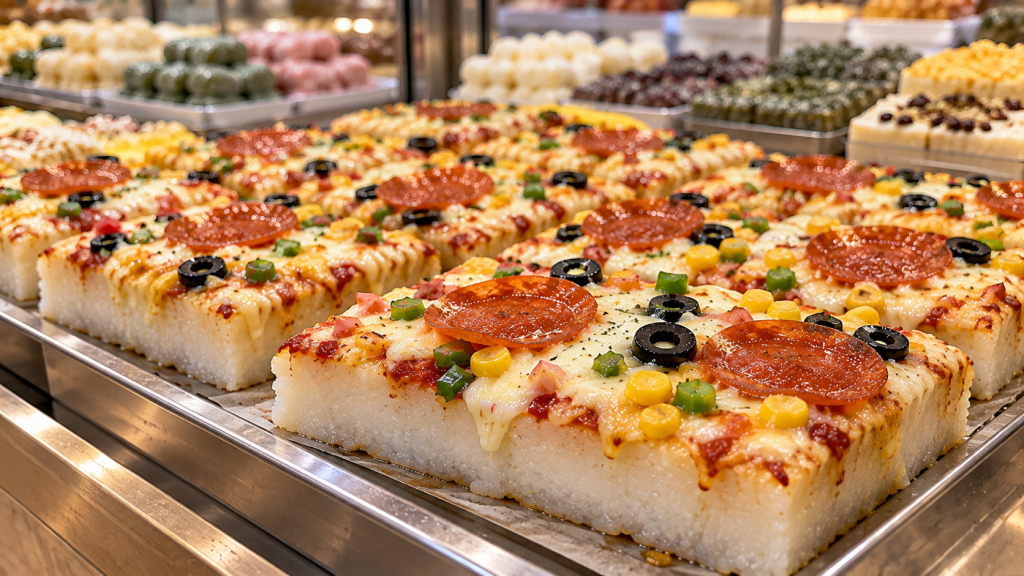
The cheese is melted. Pepperoni sits on top. Even the thick white base makes it look like a small pizza. But take a bite, and it isn’t bread.
It’s tteok.
Then there’s the line. On a weekday morning, people wait inside a local market to buy it.
In Korea, there is even a name for going out of your way to visit famous tteok shops.
Tteokjisullye—a “tteok pilgrimage.”
Tteok Is Traditional. Pepperoni Isn’t.
That first bite is soft but springy, and the more you chew, the chewier it gets.
This is pizza seolgi.
Seolgi is a type of tteok made by steaming rice flour, and tteok itself comes in a wide range of textures, from soft and fluffy to deeply chewy.
Tteok shows up at holidays and family celebrations, but people also pick it up as an everyday snack from neighborhood tteok shops.
Now cheese and pepperoni sit on top of that familiar food. The toppings are new. The texture underneath isn’t.
An old food has a new look—one that makes people look twice.
Even Buying Tteok Has Become a “Pilgrimage”
Korea already had a joke word for bakery-hopping: ppangjisullye.
It swaps the first syllable of seongjisullye, the Korean word for pilgrimage, with ppang, the word for bread. The joke is treating famous bakeries like holy sites.
Now the same joke has reached tteok shops—and that’s where tteokjisullye comes from. The word sounds grand, but the behavior is easy to understand.
Try the tteok you were curious about, and another shop’s famous tteok becomes your next stop.
At one shop, people seek out pizza seolgi. At another, they go for tteok filled with fruit. Somewhere else, the draw is tteok layered with red bean paste and butter between crisp wafers.
Some tteok now make you think, “I want to try that.” And you see more people making special trips to the shops that sell them.
A Holy Site Has to Be Worth the Trip
People waiting outside a tteok shop often already know exactly what they came to buy. They aren’t walking in, looking at the display, and deciding what looks good.
Some have traveled the better part of an hour just to buy it. Others have tried it once and come back for more.
And when it’s not something you can order online, there’s only one way to get it: you have to go there.
First, there’s a tteok you want to try.
You find out which shop sells it.
You make the trip.
When you get there, you wait.
And finally, you buy it.
Of course, none of this is entirely new. Many parts of Korea have their own well-known tteok shops, and people have long sought out their specialties.
What stands out now is that it’s happening in so many places at once, centered on particular tteok.
Not every tteok shop becomes a holy site.
A tteok shop becomes a destination when people have a reason to go all the way there.
The Tteokjisullye Map Now Lives on Your Phone
For some people, tteokjisullye starts on a phone screen—and ends up back there.
A tteok that looks like pizza, or one with a striking cross-section, raises a question in a single photo or short clip:
“Wait, that’s tteok?”
Once they’ve made the trip and have the tteok in hand, out comes the phone again. They open the package and take a photo.
At first, someone else’s post led them to the shop. Now the tteok they bought goes back onto a screen.
The display case of a neighborhood tteok shop now stretches all the way to your phone.
Even a tteok shop tucked inside a market alley can show up first on the screen of someone in another neighborhood—or another city.
Pilgrims Aren’t the Only Ones on the Move. So Is Tteok.
A hit menu item doesn’t stay in one place.
One tteok shop started making pizza seolgi after customers asked for one they had seen at a shop in another region. Another shop owner went to a well-known shop, waited in line to try its pizza seolgi, then came back and created a version of their own.
As pizza seolgi reaches other markets, the ingredients change too. Pepperoni might give way to potato or sweet potato, or a familiar Korean flavor like bulgogi.
While people travel in search of tteok, the ideas behind it move from shop to shop.
And that movement doesn’t stop in market alleys.
A department store has even brought well-known regional tteok shops together for a nationwide tteokjisullye event.
Tteok shops scattered across separate neighborhoods are now being connected through a single question: Where should you go, and what should you try there?
Young customers line up outside tteok shops with phones in hand.
Older customers come after seeing pizza seolgi on a screen and wondering what it tastes like.
Foreign travelers in Korea stand in front of the display case, picking out unfamiliar tteok one by one.
Tteok has been there all along.
But now, people have far more ways to discover it—and find their way to it.



Leave a comment